
Back in 2017, Damien Leone‘s Terrifier landed on Netflix and it quickly became a major topic of discussion on Horror Twitter™. Previously, I had only been aware of the psychotic Art the Clown from the random times I came across the cover art for All Hallow’s Eve, an anthology that featured Art in one of its segments. When I decided to finally check out Terrifier, it changed me in a major way; it made me hate Terrifier, Art the Clown, and anyone who said this movie was anything other than putrid garbage. Eight years later, I’ve begrudingly come to question a lot about Terrifier and Art the Clown, leading me to wonder if I need to let go of all the reasons I hate this franchise and accept that it serves as horror’s future (or if maybe I’m still right and these movies are still an all-time great horror grift).
The reason I avoided ever watching All Hallow’s Eve is because, at first glance, I had assumed the movie would offer audiences little more than the question, “What if a clown was a psycho?” It’s truly one of the least creatively inspired questions posited in the horror realm, akin to, “What if a doll was creepy?” These are base-level questions that would only really appeal to the lowest common denominator of audiences. When I jumped into Terrifier, not only were my fears about Art the Clown fully confirmed, but the movie itself was even more repugnant than I could imagine.
For those unaware, the original Terrifier unfolds on Halloween night (I’m always a sucker for movies set on October 31st!) and follows two women being stalked and ultimately tormented and killed by Art the Clown (David Howard Thornton). The direction, story, and script are all atrocious, reminding me of countless other low-budget horror movies I’ve subjected myself to over the years. The special effects were horrendous, and not in the way that they were effective and looked gruesome, but more in the way that I felt like I was watching mannequins being eviscerated. Not very convincing stuff, guys! I’ve disagreed with popular horror opinions before, so I was willing to chalk this opinion up to “don’t worry, Wolfman, you’re on the right side of history again.” Though, when Terrifier 2 came out and it was being praised for being even better than the original, I once again waded into the waters of this franchise with an open mind, and was punished for it.
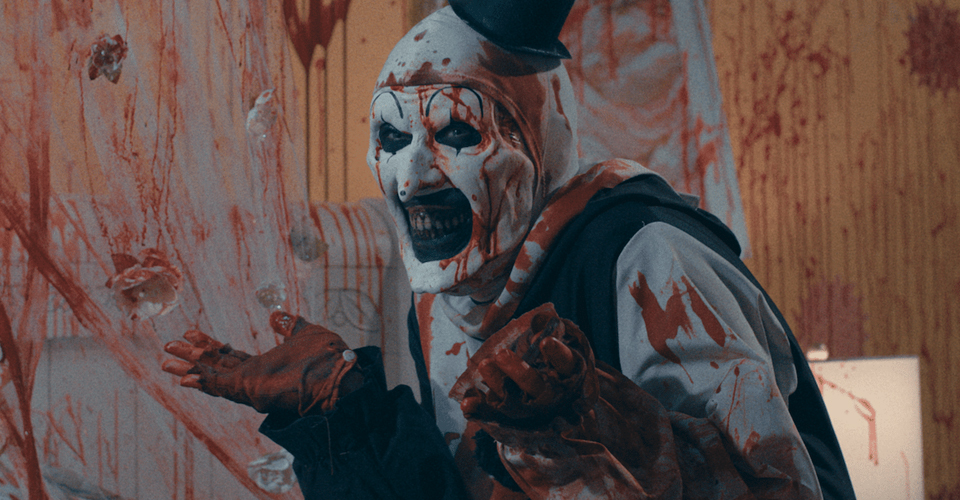
Terrifier 2 is longer than the original (this sequel has a run time of 2 hours, 18 minutes), which cancels out the fact that some of the special effects are, in fact, superior to the original. Still, the filmmakers continued the trend of creating a narrative that is less of an ambitious, compelling story and more of a razor-thin mythology that just serves as an excuse to deliver viewers stomach-turning violence, with women largely being subjected to this severe brutality. Even though the sequel only further cemented that these movies were made by and for Edgelords, these Edgelords were turning up in droves: Terrifier 3 would go on to take in $90+ million, despite its budget being a mere fraction of this figure.
The result? Me having that “Am I so out of touch? No, it’s the children who are wrong” Principal Skinner moment. Even with my staunch detestation of Terrifier both as movies and as a fandom, I may have reached acceptance that these movies aren’t, in fact, the worst thing to happen to horror in the past decade.
Following the success of the first two films, I started seeing an even further surge of Terrifier-related merch offerings across horror retailers, to the point that you could even go into a Spirit Halloween and buy a life-sized Art. The series has so firmly infiltrated pop culture that the franchise has an entire, multi-million-dollar haunted house currently operating at Halloween Horror Nights in both Universal Studios Orlando and Universal Studios Hollywood. Even with how much I despise Terrifier, I recently ranked that house as one of the better ones at this year’s event. While I’ve already subjected you to all the reasons these movies only confirm how creatively vacuous the horror genre can be, I’m going to attempt to … defend these films as … not awful. (This truly pained me to type, as anyone who has ever spoken to me about this franchise can attest.)
Back in the 2000s and even up through 2023’s Saw X, the Saw franchise and many of its “torture porn” derivatives held the honor of delivering audiences gruesome visuals that lacked any narrative weight or interest. Compared to Terrifier, however, the Saw series now feels like “elevated horror,” given how surface-level Leone’s films are in what they deliver. Both in walking through the Terrifier haunted house and in my recollections of the first two films, Leone seems to have the singular vision of delivering audiences the most vile, repulsive, violent acts imaginable, in which no on-screen character is safe. In this sense, I can’t deny that Terrifier succeeds in trying to put the most heinous, depraved acts imaginable in a movie. While the ’80s birthed a number of movies that were deemed “Video Nasties,” Terrifier does feel like an attempt to deliver sickos the gnarliest, evilest stuff imaginable, and given that this is the horror genre, these movies feel like an attempt to earn such a reputation. While countless other slashers have been deemed worthless trash that offer nothing of value, signaling they were made by and for the morally bankrupt, Terrifier seems to want to revel in such labels.
Leone confirmed this thesis earlier this year with his own obtuse, ignorant remarks on Facebook about how his films are a “pure form of entertainment.” In short, Thornton was being quite active on social media to decry our current political administration and support the LGBTQ+ community, which resulted in him earning death threats. Rather than just a short and simple “please don’t send death threats to my cast or crew” message, Leone opted to say his films weren’t political. Given that politics consciously or unconsciously play a part in literally everything we do, whether we want them to or not, Leone’s tone-deaf statement confirmed that his goal with these movies is purely surface-level and implied that no one should ever try to extrapolate any deeper meaning from them. (Sure, plenty of people have deduced from the on-screen antics that Terrifier comes across as misogynistic violence, but it seems as though Leone just wants you to sit back and “enjoy” women and children being subjected to torture and murder.)
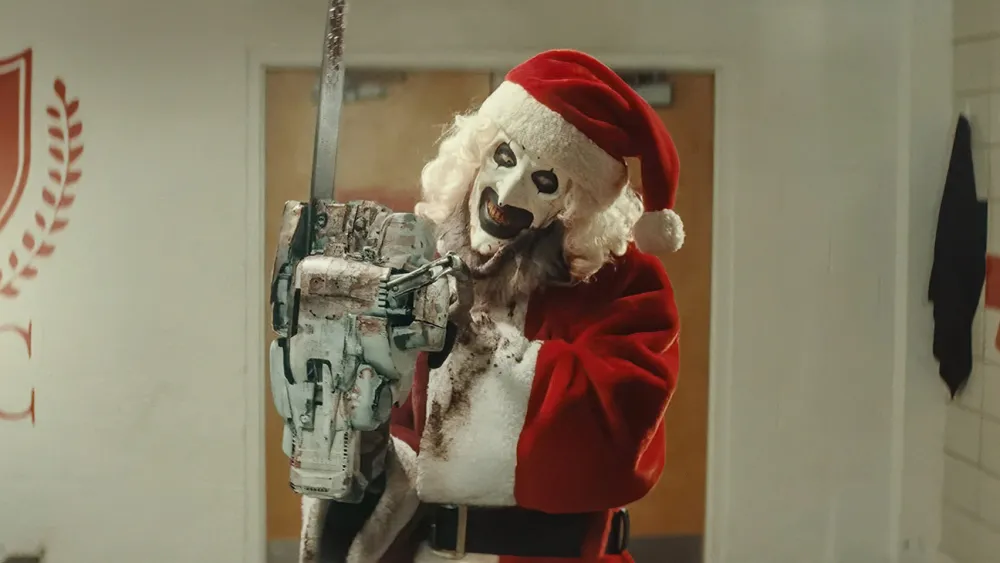
In the early 20th century, movie audiences were given iconic monsters with Dracula, Frankenstein’s Monster, and The Wolf Man (not me, the guy in the movies). It would take until the ’80s for horror audiences to earn a seminal roster of new monsters, thanks to Halloween‘s Michael Myers, Friday the 13th‘s Jason Voorhees, A Nightmare on Elm Street‘s Freddy Krueger, Hellraiser‘s Pinhead, and Child’s Play’s Chucky. While the ’90s gave us Scream‘s Ghostface and the Saw series gave us John Kramer, filmmakers’ push in recent years to embrace horror’s roots of using genre storytelling as an opportunity to say more about the human condition has resulted in an absence of horror mascots, which Thornton’s Art has rightfully become. The actual aesthetics of Art aren’t all that creative (again, the entire thesis seems to be “what if clown was psycho?”), yet Thornton’s goofy and deranged physical performance makes for something at least watchable in movies that offer nothing substantive cinematically. Witnessing Scareactors at Halloween Horror Nights channeling Art’s childlike mentality was far more entertaining than anything I’ve actually seen in a proper Terrifier movie, as his antics were entirely crowdpleasing. Even if I can’t see myself ever buying a piece of Art the Clown merch, Thornton’s performance and his overall look have filled the vacuum of contemporary horror mascots. Trick ‘r Treat‘s Sam might be the next-best figure, and is better than Art is every way, shape, and form, but with only one movie under his belt, Sam hasn’t quite earned the same pop-culture foothold.
Anyone who has followed this blog since the beginning (what is wrong with you?) might recall how interesting the horror landscape was in the late 2000s and early 2010s. Streaming didn’t exist, so movies earned wide theatrical releases, limited theatrical releases, or went straight to DVD. Films that largely exceeded the merits of mainstream releases never earned their deserved followings because of how hard they were to watch. By the mid-2010s and up through now, streaming platforms became the go-to destination for movie viewing, especially for more casual movie fans. While the original Terrifier and All Hallow’s Eve both earned a following thanks to these streaming platforms, both Terrifier 2 and Terrifier 3 have become eventized with theatrical releases. Cinephiles and horror fans are currently more appreciative of the theatrical experience than ever, as we know that there are few things as magical as seeing a movie big and loud in a theater, especially after the years we spent being relegated to only watching movies on our TVs during the pandemic. While repertory theaters were a regular hotspot for horror fans for one-night-only screenings, Terrifier sequels have proven how much can be taken in financially with eventized screenings, as some of the biggest theater chains in the country have taken more gambles on such releases. Rather than commit one screen to a week-long run of a movie that solely appeals to freaks, a theater can likely make just as much with a one-night event that brings all these freaks together. Terrifier hasn’t fundamentally altered the theatrical virtues of even the most brutal of movies, but it has certainly set a precedent that makes major chains and distributors more interested in giving these movies a chance on the big screen.
There’s some absolute truths that I’m willing to confirm as of the time of this writing: I have seen the first two Terrifier movies and they both stink, though their existence could be a net positive for horror fans that don’t necessarily signal an overall decline in the intellect of the horror community as a whole. As we get closer to December, I might ultimately concede and give the holiday-themed Terrifier 3 a shot and decide one way or another what Terrifier ultimately means for the horror genre, but for now, I’m happy to confirm that these movies are undeniably good for horror fans, or they might assuredly be terrible. See? No wishy-washy opinions over here!
 The Wolfman Cometh