
Here’s the thing: I don’t really know much about Dolly Parton. I guess, in theory, I support her and I support fans of her, because a lot of people I like a lot like Dolly Parton a lot. Regardless of her country music drawing the attention of a lot of conservative listeners, her perspectives seem to be a lot more progressive, which rocks. I do think I could recognize her song “Jolene” if someone played it, but that’s about it. Knowing so little about her, I didn’t know what to expect from Dolly, which ultimately was a good thing, as this movie was about a psycho killer in the woods and had no connection to Dolly herself.
Chase (Seann William Scott) and Macy (Fabianne Therese) head out into the woods for what is supposed to be a romantic weekend together. As the pair discovers a bizarre collection of dolls in the middle of nowhere, they initially dismiss their findings as being part of an art project, only for a psychotic figure in a porcelain mask to emerge, kidnapping Macy and putting her through all manner of psychological and physical torture.
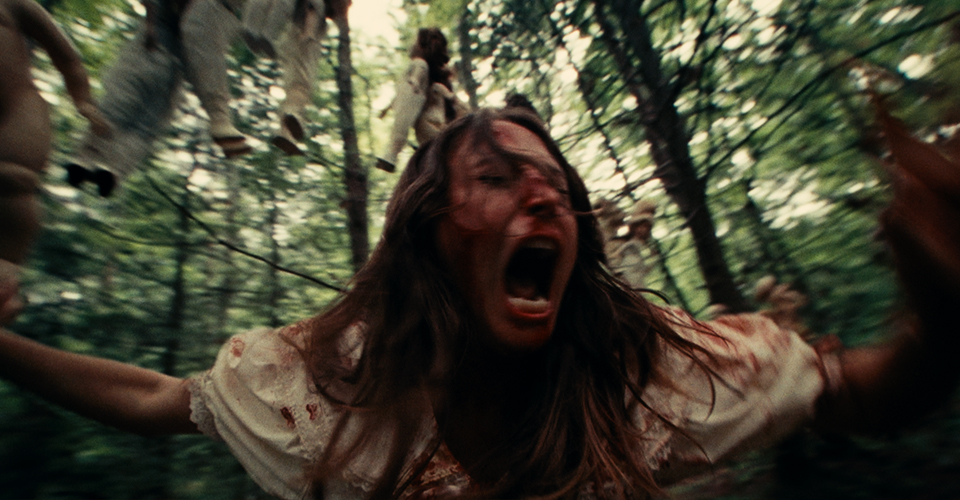
The plot of Dolly is quite thin, to put it lightly. Written by Brandon Weavil and Rod Blackhurst, with Blackhurst also directing, the duo clearly aren’t trying to forge an ambitious new path but instead pay homage to any number of classic genre movies in which weirdos torment victims in remote settings. Even with the minimal storyline, Dolly manages to keep the necessary narrative momentum to keep the viewer invested, and, without credits, it has a run time of roughly 75 minutes — the movie starts, chaos ensues, and the filmmakers pull the plug before they outstay their welcome.
The advancements in digital cameras over the last 20 years mean that the indie world has been flooded with forgettable, generic, backwoods slashers that seemingly aim to do nothing more than make slightly more money than what they cost to make. Blackhurst shot Dolly on 16mm and also utilized a number of practical gore effects, which combine to make for a pretty brutal experience. The filmmakers didn’t really get much of a chance to cheat viewers by using VFX, instead trying to capture as much carnage as they could in camera, which will satisfy gorehounds. The drawback to shooting in 16mm is how similar it looks and feels to The Texas Chain Saw Massacre, with these similarities only amplified by the fact that both movies feature big weirdos in masks terrorizing women. However, if you’re going to say a contemporary movie reminds you of such an iconic film, there are worse movies to be compared to. Even with the limitations of 16mm cameras, Blackhurst manages to deliver some impressive camerawork, which must have been all the more challenging to pull off with obsolete gear.

Much like the narrative momentum manages to keep the viewer engaged, a huge portion of the movie works thanks to Therese’s tortured performance. Admittedly, this means she’s doing a lot of shouting and screaming, running from one place to another, sometimes fighting back, and sometimes accepting her fate. The material might not have allowed her to explore her entire range as an actor, but given her prevalence in genre films a decade ago, thanks to movies like John Dies at the End, Starry Eyes, Southbound, and Teenage Cocktail, it’s nice to see her back in a horror movie after what seems like quite a few years away. Scott gives the requisite performance as the loving partner and Ethan Suplee also shows up in a small role, though Dolly actor Max the Impaler will be earning a lot of deserved attention for their physical and near-silent performance. Even with only a few words, they managed to convey vulnerability, derangement, and ferocity throughout the whole experience.
Dolly doesn’t want to reinvent the wheel so much as it wants to give that wheel a hearty spin to remind audiences why this wheel has been turning for so long. The on-screen violence is shocking and the concept is freaky as hell, with Therese’s performance and her character’s encounters with Dolly sure to earn this movie a lot of fans from the slasher crowd. I am not really a member of that crowd, so it didn’t really resonate too much with me, but given my pessimism about the subgenre as a whole, even managing to keep me entertained should be considered a success. All in all, Dolly is unpleasant and disturbed, which makes it a terrible representation of Dolly Parton.
Wolfman Moon Scale

 The Wolfman Cometh