
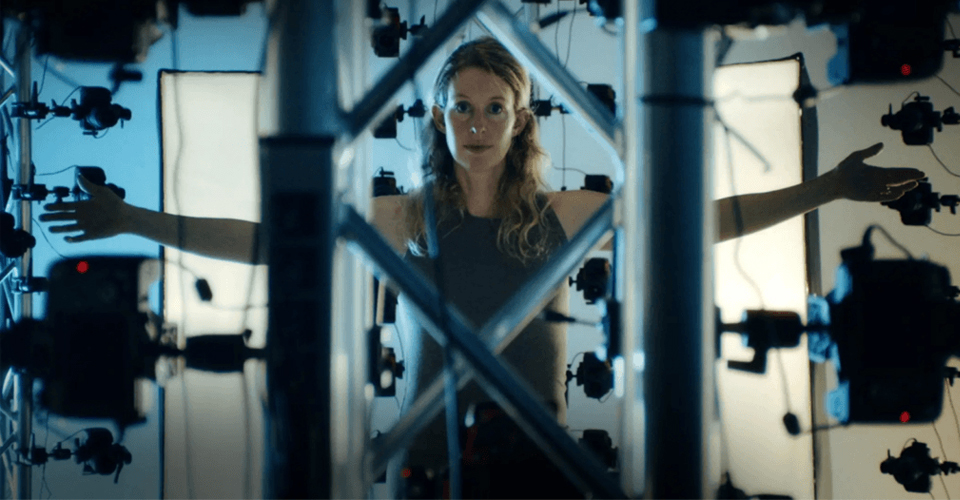
My screening for Nathan Fielder and Lance Oppenheim‘s new documentary You Can See Everything was delayed by a few minutes, and as I sat there staring at the screen with the movie’s poster on it, my mind began to wander. Is the movie title “You can see everything,” meaning it’s an invitation offering someone to see whatever they would like, or was it a statement of objective fact: “You can see everything…it’s all right there to be seen.” Luckily, the movie interrupted my “deep” thoughts, and as the documentary chronicled Elizabeth Holmes in the days leading up to her prison sentence, I realized my debate about linguistics was at the heart of the movie’s thesis and Holmes’ entire downfall.
For those unaware, Holmes was the founder of biotech company Theranos, which was developing a machine that could run hundreds of tests on one blood sample, and at an affordable price. The machine never worked, and Holmes was found guilty of defrauding investors and earned a prison sentence of 11 years. In hopes of correcting her reputation as a monster, Holmes and partner Billy Evans invite Fielder to stay with them for the 34 days leading up to her sentence. Holmes was largely unaware of Fielder’s work, with Evans admitting that he wanted Fielder to be the one in charge of the project because he thinks Fielder sees the world in a way others don’t, which is the same opinion he has of Holmes.
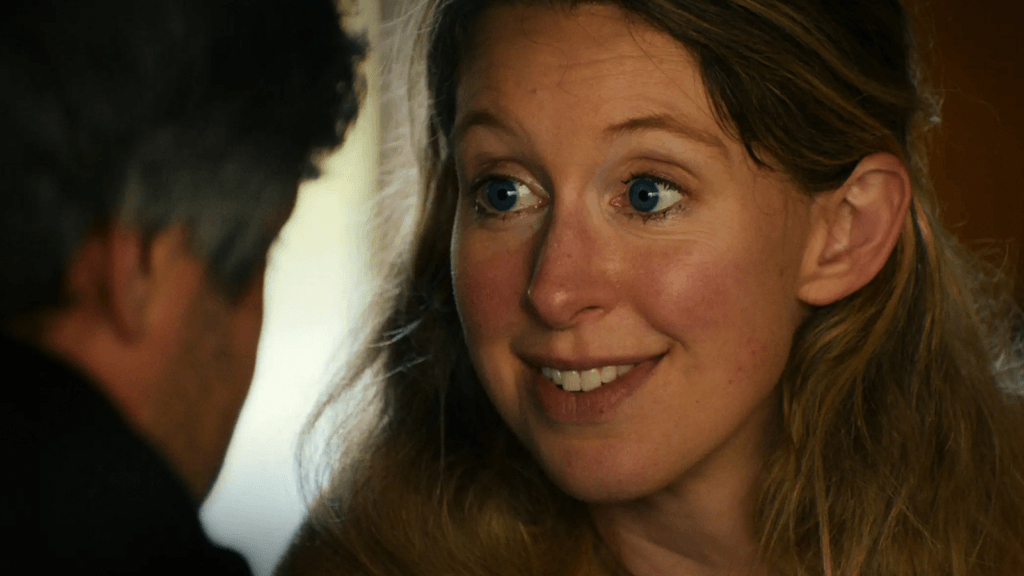
In these few weeks, Fielder struggles to get an understanding of who Elizabeth (who is actually called Liz by those close to her) really is and if she is the person the media portrays her to be. While Liz could be someone who was exploited and took the fall for people manipulating her, it’s also possible that she’s been the one manipulating everyone around her. Fielder, Oppenheim, and the audience do get a better glimpse into her interpersonal relationships, which could explain how she ended up where she is, with the search for answers frustrating everyone.
If you’ve been following this movie in any capacity over the last few weeks, you likely know that the events of it are being shrouded in secrecy and anyone related to the movie is begging anyone who sees it to keep its reveals to themselves. Anyone expecting a revelatory bombshell reveal like in the season finale of The Jinx or even something as insane as the gas station owner who confesses, unprompted, to drinking his grandson’s urine when he gets scared on Nathan for You should temper their expectations. You Can See Everything will have you looking at Holmes in a new light, but be careful not to buy into the implication that this movie could alter the entire trajectory of your reality. Instead, the movie falls more in line with what Fielder has accomplished with his The Rehearsal on HBO, as he takes what could seemingly be an innocuous premise and uses the platform to unravel the complex layers of an individual.

With Fielder and Oppenheim both credited as directors, the final product feels like a seamless union between their two filmmaking styles. The overall look and aesthetic of the movie is naturalistic in a way that resembles Oppenheim’s Spermworld, while the way Fielder engages with his subjects results in passive, low-energy conversations that strip away any of Fielder’s presumed intentions with his line of questioning. The way the movie unravels is the epitome of “give someone enough rope, and they will hang themselves,” as both Liz and Billy regularly offer up information that Fielder wasn’t seeking and that at least somewhat incriminates them. This doesn’t mean legally, but it definitely cements various theories about the duo.
What You Can See Everything really accomplishes is the exploration of intent, perception, and subjective realities. Countless conversations between Liz and Billy are analyzed extensively by Fielder and other participants in the project, and even when Fielder attempts to directly address the most minute details, he can’t get a straight answer from Liz or Billy, because their intent with their word choice can be interpreted in multiple different ways. For example, using the word “can,” like in the title, could both imply a present fact and a future possibility. Liz and her perception of the world around her don’t align with everyone’s interpretations, so while there is something unique about her worldview, she’s merely a conduit for every audience member; is saying you’re busy to get out of going to a work event a lie? Does everything you need to say have one objective definition? Who is to blame for any miscommunications: the person delivering the message for not being clear, or the person interpreting the message based on their own worldview and biases?

My only real connection to Elizabeth Holmes is vaguely remembering her being on the covers of magazines when she got busted, and, like many other people in the world, saw her story unfold in The Dropout on Hulu. My reaction to that series was “oh interesting” and, once I watched the finale, I completely moved on. As far as scandals from the last decade go, I thought it was one of the less interesting ones, and because I have a (somewhat) fully formed frontal lobe, I know that what I saw in The Dropout was fictionalized, at least in some part, to tell a more engaging story. When I heard that this movie would focus on Elizabeth Holmes, I thought, “Who?” However, different people connect with different celebrity scandals, so anyone who was particularly interested in Elizabeth Holmes and what happened to her will be much more engaged by every conversation with her, though I was much more interested (or disinterested) in her as an individual as opposed to her reputation.
At nearly three hours long, You Can See Everything is quite the commitment, and while there’s an argument to be made of “why wasn’t this a limited series?” the answer is likely that the narrative doesn’t have the standard act breaks or shocking reveals that a standard true-crime limited series has. While I won’t spoil the “shocking” reveals of the movie, Fielder and Oppenheim do break the mold of a standard documentary in that it doesn’t just present a narrative; it also depicts the reaction that an outsider has to the material. In a world where countless documentaries are dumped on streaming services, it’s a crowded field where some uninteresting stories gain enough attention to warrant underwhelming follow-ups, while more compelling stories don’t break into the zeitgeist the way they deserve. You Can See Everything is the rare documentary that not only chronicles a subject, but also offers a conversation with itself as subjects analyze and interpret what could seemingly be objective footage. It’s impressive to see how Fielder has expanded his creative vision since the early days of Nathan for You, and between this and Primetime, Oppenheim is two for two in his explorations of the various facets of famous figures you think you know everything about.
Wolfman Moon Scale


